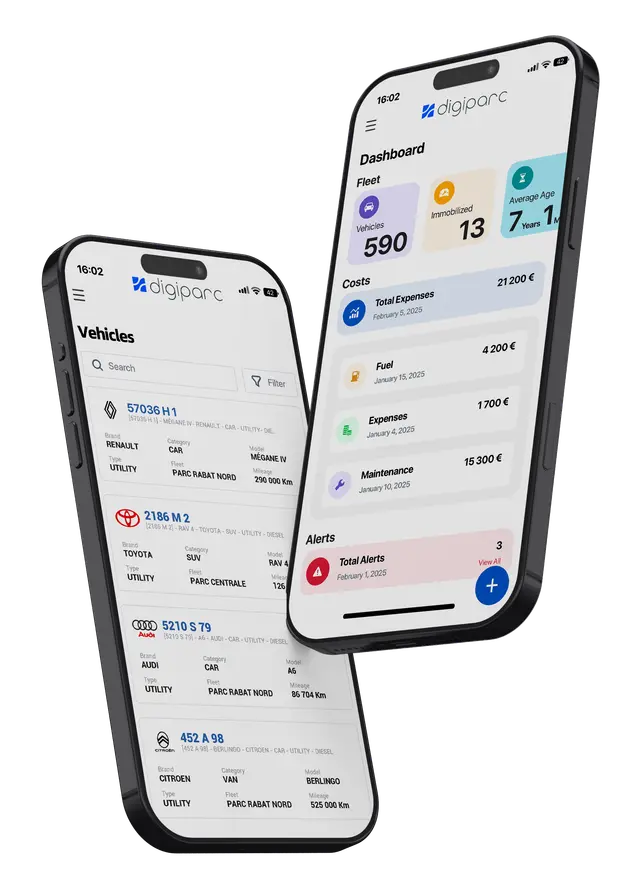
DIGISOFT has invested heavily in research and development in order to continually improve the functionalities of DIGIPARC. The latter are therefore subject to the following sections:
The reporting module:
This module has been carefully reviewed by the DIGISOFT team, in order to make it considerably richer in terms of reports and output states, in this sense below the reports incorporated according to the following modules:
1. Classification of vehicles:
- Mileage traveled less than 1000 km: mainly for long-term rental vehicles, this report presents the list of vehicles having not exceeded 1000 km per month
-
- Distribution of rental vehicles: this is the breakdown of rental vehicles by category and by fleet over a period, with a comparison with their situation at the end of December of the previous year.
-
- The distribution of heavy goods vehicles: through a report whose principle is similar to the previous one.
-
- The list of main vehicles: a report that allows you to export the complete list of the vehicle fleet by site or by supplier
-
- Insurance: detailed in this report are the insurance granted for each vehicle in the fleet.
-
- The table of statistics and performances: this report presents for each month of the year the number of vehicles in the fleet, the expenses mobilized and the mileage traveled,
-
- The list of shared vehicles:
-
- The list of vehicles on the move: presented in the form of a report which lists the vehicles on the move while detailing the following information: the driver, the date of departure and the expected date of return, the city and the assignment of the vehicle.
2. Consumption management
- Fuel consumption bill: in the form of a list which brings together, for each month, the total amount spent on consumption for each vehicle based on its internal order.
-
- Amount per cost center for heavy goods vehicles: this report uses the same principle as the previous one based on the cost center.
-
- The list of fuel vouchers: this list is a state which allows you to view all the fuel vouchers entered in the application (voucher number, date, station, direction, site allocation, quantity, fuel amount and driver), the display of data can be done based on the vouchers relating to a given vehicle, over a period or by station
-
- The list of service vouchers: this report is based on the same principle of the report above, to display the state of consumption vouchers relating to services: car washes, motorway tolls, etc.
-
- State of overall site consumption: a report which provides for each site, station period, the total sum of diesel, gasoline and service expenses according to directions, allocation, quantity and amount
-
- The list of vehicle expenses: this report has been set up to detail its expenses for each vehicle by category (fuel, washing, parking, toll, etc.) and over a given period.
3. Cost management:
- The Expenditure Estimation Table: this report allows you to estimate the budget allocated per station, based on expenses relating to fuel and services.
Intervention management:
From now on, maintenance management on DIGIPARC is even more developed, thus meeting the quality requirements, hereinafter the new intervention management procedure:
- Editing the intervention request
-
- Établissement du diagnostic sur le véhicule en question
-
- Prise en charge du véhicule
-
- Gestion des devis de réparation
-
- Edition of one or more interventions for the same request, while specifying the repair location, the start date and the end date, the parts used and the labor mobilized.
Intervention statistics:
Just like the “reporting” module which has been enriched, the DIGISOFT team has also invested in decision-making support tools and performance indicators, in this sense DIGIPARC provides for each site:
- The number of current intervention requests
-
- The number of interventions in progress
-
- Le nombre des interventions
-
- Le nombre des interventions clôturées
Alerts on maintenance plan operations:
The operations configured in the maintenance plan are preventive type maintenance operations, which are required regularly based on a kilometric or hourly frequency.
Based on this principle, DIGIPARC triggers alerts on each operation based on the last intervention, these alerts will also be sent by email to park managers in order to report the information and trigger action in time.