.jpg "Déterminer le coût total de possession")
The TCO of a fleet adds acquisition, operation, taxation and residual value. Find out how to determine it, position by position.
What is total cost of ownership?
The total cost of ownership, or TCO (total cost of ownership), is the true cost of a vehicle — or any fleet asset — over its entire life cycle. It is not limited to the purchase price: it includes what the company pays to own, finance, use, maintain and, ultimately, sell the vehicle.
The purchase price is a single amount, visible at the time of ordering. The TCO is built over time: financial charges, fuel, maintenance, insurance, taxation, possible fines and loss of value. A less expensive vehicle to purchase therefore does not necessarily have the most advantageous TCO.
On a vehicle fleet, the operating costs accumulated over several years often exceed the acquisition cost alone. Determining the TCO means making this difference readable to compare vehicles, categories or financing schemes.
TCO of a vehicle and TCO of a fleet
The vehicle TCO is calculated for a given registration: the positions of this vehicle are attached over a period. Fleet TCO is not another definition: it is the aggregation of these vehicle TCOs – possibly grouped by site, by energy, by type of use or by method of acquisition (purchase, rental, leasing).
This two-scale reading avoids two pitfalls. Isolating a single vehicle without replacing it in the fleet masks the volume effects. Conversely, a single fleet total, without detail by asset, prevents the identification of vehicles that are too expensive or underutilized. We first determine the TCO per unit, then we consolidate it.
Which positions should be included in the TCO?
The items vary depending on the contracts and the organization, but they are grouped into three families: relatively stable expenses, expenses linked to use, and changes in the value of the asset.
Fixed costs
Fixed costs remain comparable from one period to another, regardless of the kilometers traveled. It contains in particular:
- the purchase price or financing charges (credit, rental, leasing);
- insurance;
- vehicle taxation (taxes, stickers depending on the country);
- fleet administrative management costs when they relate to the vehicle or fleet.
These amounts are not “fixed forever”, but they do not keep pace with fuel or breakdowns. They structure the basis of the TCO.
Variable costs
Variable costs depend on actual use: distances, operating conditions, maintenance. We find in particular:
- fuel and other energies;
- routine maintenance and repairs;
- spare parts;
- fired;
- tolls, fines and other costs related to use.
It is often in these areas that the TCO of a vehicle differs from another, at a comparable purchase price. Without a history of use, we underestimate the total cost of ownership.
Depreciation and residual value
Depreciation is the loss of value of the asset over time. The residual value is what the vehicle can still represent upon resale, at the end of the contract or at the time of replacement. Both correct the TCO: a higher acquisition cost can be offset if the vehicle depreciates less, or resells better.
This dimension begins at the time of purchase. A low entry price is only advantageous if exploitation and exit value remain under control. Conversely, a vehicle that is more expensive to purchase may have a more favorable TCO over the life cycle.
How to determine the TCO?
There is no single magic formula: TCO is determined by consolidating the same items, over a comparable period, with data linked to the vehicles. A useful approach is to:
- define the analysis period (year, holding period, contract period);
- identify the items to be included, fixed and variable, including the residual value;
- collect data: invoices, contracts, consumption, interventions, mileage;
- consolidate costs by vehicle, then by fleet or by category;
- compare vehicles or categories over the same period;
- follow developments over time, rather than a single snapshot.
The objective is not an isolated figure, but a reproducible reading: which positions weigh, which vehicles drift, which financing scheme remains consistent with real use.
Read the TCO per kilometer
The cost per kilometer relates the TCO – or part of its items – to the distance traveled over the period. It does not replace the total cost of ownership: it makes it comparable between vehicles that do not have the same mileage.
A high annual TCO on a heavily used vehicle can remain reasonable per kilometer; the opposite is true for a little-turned asset which continues to carry insurance, taxation and depreciation. Reading the TCO per kilometer helps to judge usage, not just the overall bill. This is a reading indicator, not a separate method.
Visible costs and poorly consolidated costs
Managers generally see the most obvious items: acquisition, some maintenance invoices, sometimes fuel. Other amounts exist but remain dispersed: financing contracts, insurance, taxes, tires, interventions, consumption, fines.
Without being linked to the vehicle and the period, these expenses do not disappear: they escape the TCO. The difficulty is not only “finding hidden costs”, it is bringing together in the same reading sources that live in different files – invoices, contracts, fuel, maintenance and operating data.
Why a spreadsheet is often no longer enough
A spreadsheet may be enough to list positions for a few vehicles. It becomes fragile as soon as the fleet grows: multiple files, manual updates, columns that no longer correspond to contracts, mileage entered elsewhere.
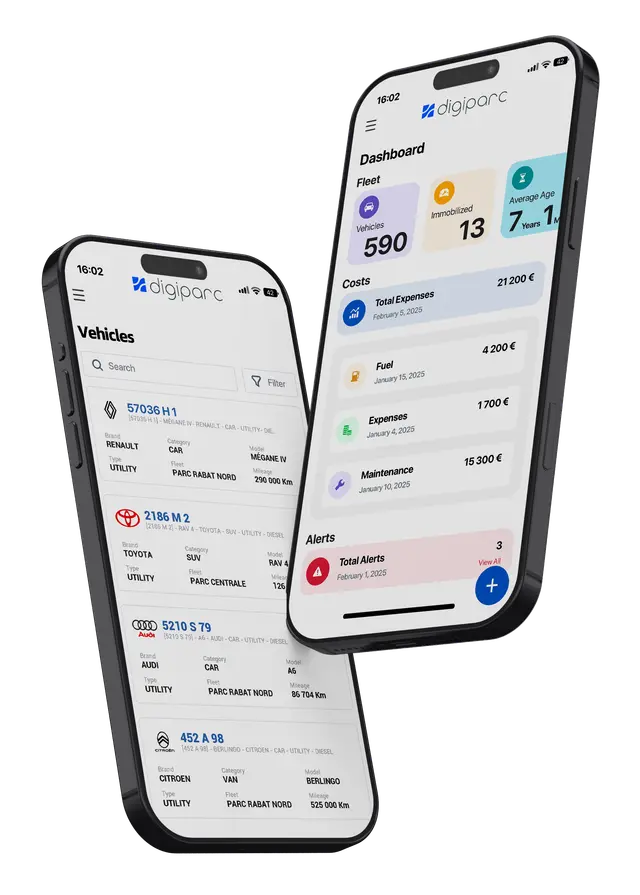
Determining the TCO requires linking sources that do not have the same rhythm: financing deadlines, fuel tickets, maintenance orders, usage reports. HASfleet management softwarecentralizes this information on the vehicle repository, to consolidate costs and compare assets without rebuilding the file at each closing. Digiparc is part of this monitoring logic, once the calculation method has been established.
Go further
Once the TCO has been determined item by item, it can be used to decide: renewal, financing, maintenance priorities. For a TCO closer to the field, see theTCO powered by field data. For concrete levers after the diagnosis,optimize fleet costsdetails operational avenues. To calculate an order of magnitude of savings depending on the size of the fleet, we canestimate the impact on fleet costs.
In addition, thewhite paper on fleet management optimizationcan serve as an optional resource to link cost visibility and fleet management.