Published September 28, 2020
Fleet Management KPIs You Should Consider
Tracking key performance indicators helps you measure the efficiency of your fleet. Establishing fleet management benchmarks and measuring KPIs is the best way to improve fleet productivity and control costs.
Fleet management KPIs are performance indicators that demonstrate the effectiveness of your fleet management strategy. A KPI is like a compass that guides you towards successful decisions to improve your fleet.
The most common performance criteria in fleet management are generally cost containment, productivity improvement and fleet efficiency.
Here are examples of fleet management KPIs you should track:
Cost control and adherence to budget
You can't improve what you can't measure. Most fleet managers aim to control expenses and maximize profitability. Unfortunately, many managers don't have a way to accurately track expenses.
Because there are so many costs associated with fleets, manually calculating expenses is an uphill battle. Not only is it difficult to ensure accuracy, but by the time it comes time to reconcile your budget, you're already behind schedule.
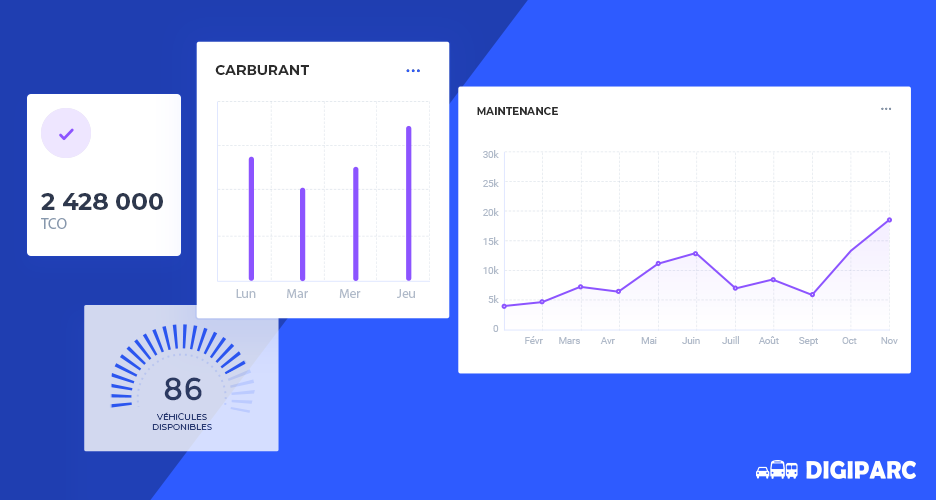
Fleet management software allows you to track expenses in real time. By managing your fleet with software, you can view expenses and automatically calculate your total cost of ownership (TCO).
Controlling costs with configurable fleet reports allows you to confirm your fleet trends and take necessary actions to improve them.
Maintenance management and downtime prevention
Developing key performance indicators (KPIs) for fleet management helps ensure that your vehicles are maintained correctly and as quickly as possible. By prioritizing vehicle maintenance, you reduce downtime and maximize efficiency.
To avoid recurring issues, fleet managers must take a proactive approach to maintenance. Following a preventative maintenance program helps identify and repair problems before they become serious and cause downtime.
Optimal vehicle replacement objectives
We discussed expense management and maintenance. These two aspects of your fleet management plan can help you make one of the most difficult decisions for your fleet: vehicle replacement.
Determining the best time to replace vehicles is complex. You want to get the most out of your assets, but there comes a point of diminishing returns with every vehicle. At some point, maintenance expenses exceed the cost of a new vehicle. Using software to monitor vehicle condition and expenses can help identify optimal replacement windows.
Fuel costs
Fuel is one of the largest ongoing costs for fleets, and although unavoidable, fuel costs can be managed. Tracking fuel consumption and expenses in centralized software allows you to develop improvement strategies.
Tracking fuel consumption is time-consuming if you're trying to keep up with paper receipts and manual data entry.
Having drivers or other agents enter fuel entries into the fleet management software saves time and visualizes fuel costs in real time. For greater efficiency and access to additional fuel data, fleets can integrate their fuel cards with DIGIPARC.
Driver safety and behavior
Safety is a fleet manager's top priority, and just like costs and maintenance, safety can be measured. Setting fleet management KPIs around safety and driver behavior helps you ensure the safety of your vehicles, drivers and the general public on the roads.
Fleet managers can also monitor driver behavior with DIGIPARC telematics tools to identify harsh braking and speeding.
Regularly training drivers on safe driving habits and creating safety procedures can ensure your team takes safety seriously. Not only does this decrease liability, but it can also help avoid fines and violations.