Wear, rotation, retreading, cost per kilometer: how to better manage tires to reduce costs and improve the safety of your fleet?
In a car fleet or a heavy goods vehicle fleet, the cost of tires weighs much more than replacing tires. Their wear, pressure, lifespan and monitoring directly influence maintenance costs, fuel consumption and vehicle safety.
Yet many companies accurately track their fuel and repair expenses without having a complete view of the true cost of their tires.
The problem is not just the purchase price of a tire. It is also the mileage traveled, the conditions of use, maintenance operations, retreading possibilities and anticipated replacements.
So, how can you transform tire management into a real performance lever for your fleet?
Why do tires represent so much of a fleet’s costs?
Tires are essential components for vehicle operation. They are subject to permanent wear and require regular monitoring, particularly for transport, distribution and utility vehicle fleets.
Their overall cost depends on several factors:
- The purchase price and quality of tires.
- Mileage traveled and conditions of use.
- Irregular wear linked in particular to pressure, parallelism or mechanical condition.
- Swap and replacement operations.
- The possibilities of repair or retreading, when suitable.
- Unplanned downtime and interventions. A stationary vehicle also has acapital costwhich goes beyond just the tire bill.
Management limited to purchase invoices therefore does not make it possible to precisely measure the economic performance of tires.
To understand their impact, it is necessary to follow their life cycle and relate expenses to actual use. It is the same reflex as forcost managementof the park: a station is only controlled if it is linked to use.
Cost per kilometer: the indicator to follow
Comparing two tires based solely on their purchase price can lead to a bad decision.
A less expensive tire to purchase is not necessarily the most economical over time. Conversely, a more expensive tire may offer a better cost of use if it covers more kilometers in suitable conditions.
The cost per kilometer makes it possible to better compare economic performance.
Cost per kilometer = total tire cost ÷ mileage traveled.
For a more complete analysis, the company can integrate the costs of assembly, disassembly, rotation, repair and retreading, taking care to avoid double counting.
It is also important to compare similar vehicles and operating conditions: vehicle type, axle, load, route and road conditions.
The objective is to answer a simple question: how much does each kilometer traveled with the fleet's tires actually cost?
Tire wear: a signal not to be ignored
Tire wear does not only depend on the distance traveled. It can also reveal problems with pressure, geometry, suspension or operating conditions.
Inadequate pressure can accelerate wear and affect fuel consumption and vehicle behavior.
Regular monitoring makes it possible to detect anomalies and schedule the necessary interventions before they become more costly.
Fleet managers should follow:
- The condition and depth of the sculptures.
- Tire pressure according to the manufacturer's recommendations.
- Differences in wear between tires on the same vehicle.
- The assembly dates and mileage recorded.
- Incidents, repairs and replacements.
These controls help maintain safety, better plan replacements and extend operating life when conditions permit.
Swapping and retreading: optimizing the life cycle
Pull rotation
Rotation consists of changing the position of the tires according to the recommendations applicable to the vehicle and tires.
When technically appropriate, this operation can help to better distribute wear. However, it should not be systematic: the possibilities depend in particular on the type of vehicle, the assembly, the dimensions and the manufacturer's recommendations.
A history of permutations allows you to better understand the evolution of wear and plan interventions. Afleet maintenanceStructured maintains this history in the same place as other shop floor operations.
Tire retreading
Retreading consists of renewing the tread of a tire whose carcass can be reused under conditions that comply with applicable technical and regulatory requirements.
For certain heavy goods vehicle fleets, it can represent an interesting economic lever by extending the use of a suitable carcass.
But retreading is not suitable for all situations. It requires an assessment of the condition of the carcass, compliance with applicable requirements and rigorous monitoring.
The right decision is based on overall cost, safety, expected mileage and actual operating conditions.
Tires and fuel consumption: a direct link
Tires influence rolling resistance, which contributes to the vehicle's energy consumption.
Insufficient pressure can increase this resistance and lead to overconsumption. However, actual effects vary depending on vehicle, tire, load, route and driving conditions.
For a fleet that covers many kilometers, it is therefore relevant to consider tire and fuel data together.
A global approach makes it possible to better identify opportunities for improvement, without automatically attributing any increase in consumption to the condition of the tires.
How to implement effective tire monitoring?
Effective management begins with a reliable history for each tire or set of tires.
Useful information includes:
- The identification of the tire and its position on the vehicle.
- The brand, model and specifications.
- The assembly date and initial mileage.
- Pressure and wear readings.
- Permutations, repairs and retreading operations.
- The purchase cost and maintenance expenses.
- The date of collection and the total mileage traveled.
Using this data, the manager can compare costs per kilometer, identify abnormal wear, anticipate replacements and better plan budgets.
Afleet management softwarefacilitates the centralization of information and its use. The quality of monitoring, however, depends on the regularity of the readings and the reliability of the data recorded.
Key indicators for controlling tires
To move from reactive management to structured management, several indicators can be monitored:
- Cost per kilometer:measure the economic performance of tires.
- Mileage life:compare the kilometers traveled before withdrawal, taking into account the conditions of use.
- Abnormal wear rate:identify recurring problems and investigate their causes.
- Tire expenses per vehicle:understand the gaps between vehicles and fleet categories.
- Share of retreaded tires:when this practice is adapted, evaluate its economic interest.
- Tire-related incidents:monitor observed problems and strengthen prevention.
These indicators must be analyzed together. A low cost per kilometer alone does not constitute proof of good management if safety, compliance or vehicle availability are compromised.
Tires deserve real steering
Tires are both an expense, a safety factor and an important element of the operational performance of a fleet.
Just looking at the purchase price or replacement invoices is not enough. To better control costs, it is essential to monitor the life cycle of tires, understand their wear and measure their cost per kilometer.
By centralizing information and monitoring relevant indicators, companies can make more informed decisions, better plan interventions and identify optimization opportunities.
Digiparc
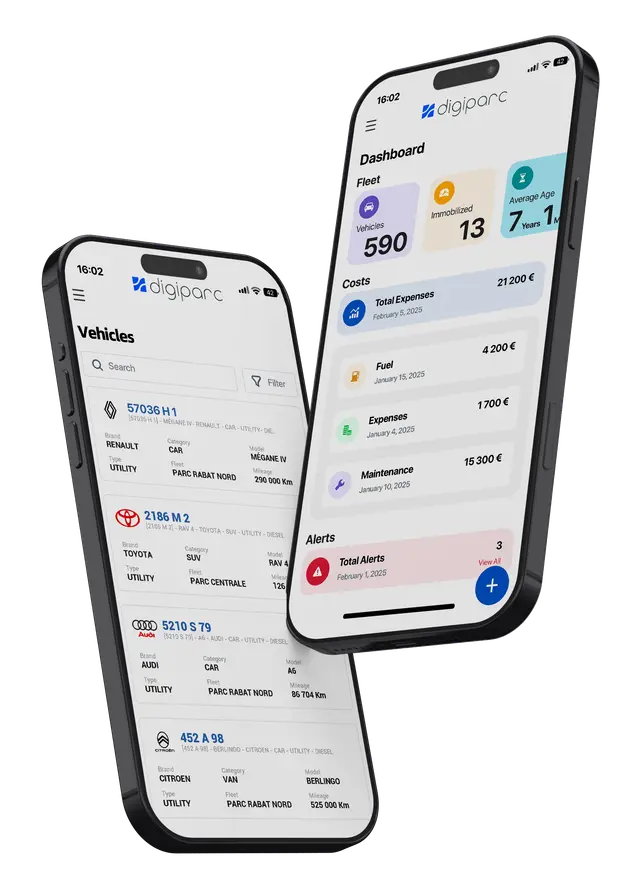
With DIGIPARC, structure the monitoring of your fleet and give your teams better visibility on vehicles, maintenance and costs. Discover theDIGIPARC solutionsfor more structured and more efficient fleet management, orask for an appointment.
To go further
Find the DIGIPARC reel dedicated to tires in thevideo library, TEAwhite paper no. 10, and the podcast episode 19 onLet's talk fleet, to explore good management practices and the economic issues of tires.