Module · GPS
Daily Fuel
Daily Fuel
Introduction
L’interfacerapport des consommations journalières en litrespermet de suivre précisément la consommation de carburant de chaque véhicule au jour le jour pour un mois donné. Elle constitue un outil essentiel pour les gestionnaires de flotte, en offrant une vision détaillée de l’usage de carburant par véhicule. Cette granularité permet de détecter des irrégularités à un niveau très précis, facilitant ainsi une meilleure optimisation des coûts et des performances.
Filtres
L'interface offre plusieurs options de filtre pour affiner les recherches et générer un rapport adapté aux besoins opérationnels :
- Flotte: Sélection de la flotte spécifique à analyser.
- Groupe de véhicules: Permet de cibler un groupe de véhicules particulier pour une meilleure précision dans l’analyse.
- Véhicule: Filtrage par un véhicule en particulier pour isoler son comportement de consommation.
- Année: Définit l’année d’analyse.
- Mois: Sélection du mois à examiner pour un suivi quotidien détaillé.

Ces filtres permettent d’obtenir une vision personnalisée et ciblée du rapport, ce qui est particulièrement utile pour identifier des comportements à risque ou anticiper les besoins de maintenance.
Tableau de Résultats
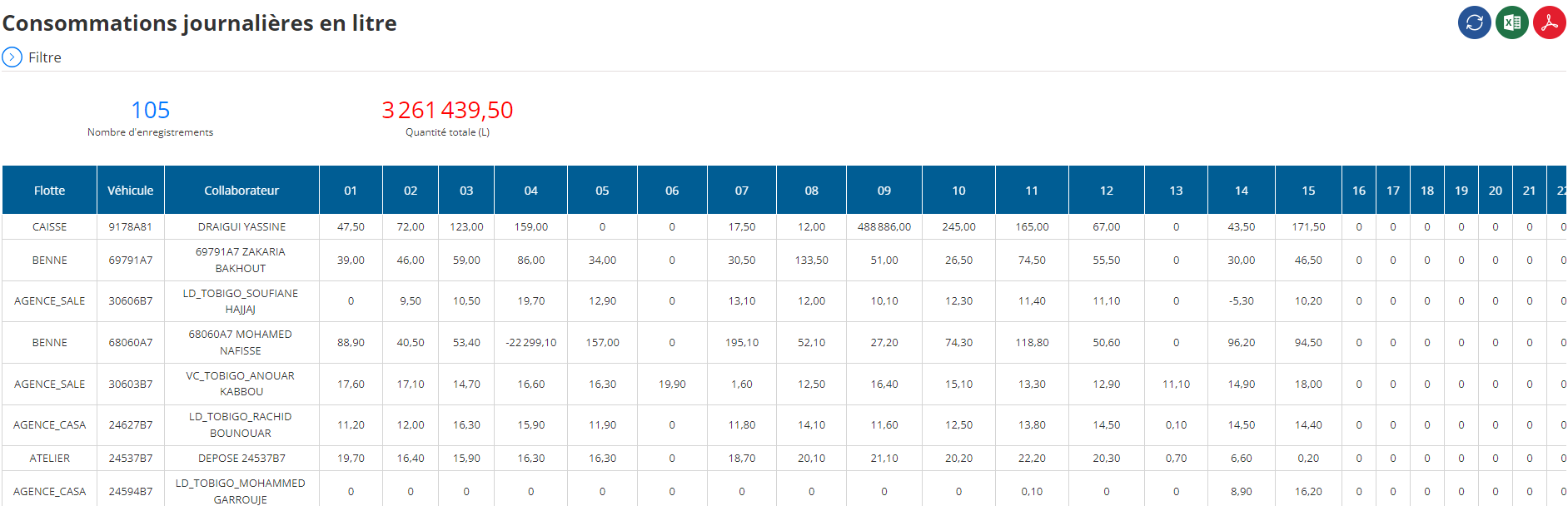
Le tableau présente la consommation quotidienne en litres pour chaque véhicule et inclut une synthèse mensuelle :
- Flotte: Flotte à laquelle le véhicule est rattaché.
- Véhicule: Numéro d’immatriculation ou identifiant unique du véhicule.
- Collaborateur: Conducteur ou utilisateur régulier du véhicule.
- 01 à 31: Consommation quotidienne en litres, affichée pour chaque jour du mois sélectionné. Si un jour n’a pas de mouvement de carburant, la valeur peut rester vide ou indiquer "0".
- Quantité totale (L): Somme totale de carburant consommé pour le mois.
Cette structure permet une analyse quotidienne détaillée tout en offrant une vue globale du mois avec le total cumulé.
Analyse Fine de la Consommation Quotidienne
L’analyse fine de la consommation quotidienne est une fonctionnalité clé permettant de suivre, avec une grande précision, la quantité de carburant consommée par chaque véhiculechaque jour. Elle offre une vision détaillée des habitudes de consommation, permettant de détecterdes anomalies, des tendancesoudes comportements non optimauxqui peuvent affecter la performance globale de la flotte.
Objectifs de l’Analyse Fine
-
Optimiser l’usage du carburant:
En suivant la consommation au jour le jour, il devient possible d’identifier des opportunités pourréduire la consommation énergétiqueà travers des ajustements dans la conduite ou la planification des trajets. -
Détection précoce d'anomalies:
Touteconsommation inhabituellesur un ou plusieurs jours (tels que des hausses soudaines) peut signaler un problème, comme :- Mauvais usage du véhicule(ralentis excessifs, conduite sportive)
- Problème mécanique(moteur ou système de carburant défectueux)
- Siphonnage de carburantoufraudesinternes
Cela permet d’agir rapidement pour limiter les pertes et minimiser les coûts supplémentaires.
-
Comparaison entre véhicules et conducteurs:
Les gestionnaires peuvent utiliser cette fonctionnalité pourcomparerla consommation entre différents véhicules ou conducteurs. Cela permet de détecter des écarts dans la conduite, de proposer desformations éco-conduiteet d'encourager lesbonnes pratiques. -
Préparation aux audits et budgets:
L’analyse journalière fournit une base solide pour :- Préparer des rapports d’auditavec des données précises et traçables
- Prévoir les dépenses mensuellesou annuelles de carburant
- Définir desbudgets adaptésà l’usage réel du parc, évitant ainsi les mauvaises surprises en fin de mois.
Suivi de la Performance des Conducteurs
Lesuivi de la performance des conducteursest une fonctionnalité essentielle pour évaluer et optimiser le comportement des chauffeurs au volant. Elle vise àaméliorer la sécurité routière, à réduire les coûts opérationnels(comme la consommation de carburant et l’usure des véhicules), et àrenforcer l’efficacitéglobale du parc automobile. Grâce à cette interface, les gestionnaires de flotte peuvent identifierles bons comportementsainsi queles pratiques à risque, et mettre en place des stratégies d’amélioration.
Synthèse Mensuelle Automatisée
La fonctionnalité de synthèse mensuelle permet de calculerautomatiquement la consommation totale du moispour chaque véhicule, offrant une vue rapide et consolidée. Elle comprend :
- Comparaison inter-véhicules: Identifier quels véhicules consomment plus que d’autres pour des trajets similaires.
- Comparaison temporelle: Analyser la variation de consommation entre différents mois pour déceler d’éventuels changements dans les habitudes de conduite ou l’état des véhicules.
- Optimisation stratégique: Repérer les véhicules ou chauffeurs à améliorer et les périodes à surveiller, facilitant la gestion de flotte sur le long terme.
Cette synthèse permet une gestion efficace grâce àdes décisions basées sur des donnéesconsolidées et actualisées.
Export en PDF et Excel
L’option d'export permet detransférer facilement les données hors de l'interfacepour des traitements ou des analyses supplémentaires. Elle comprend :
- Export PDF: Créer des rapports clairs et bien présentés, facilement partageables avec d'autres départements ou pour des réunions de synthèse.
- Export Excel: Effectuer desanalyses approfondies, créer des graphiques, et utiliser destableaux croisés dynamiquespour mieux comprendre les données.
- Gain de temps: Les gestionnaires peuvent automatiser leurs analyses en utilisant des outils externes avec les fichiers exportés.
Détection d’Irrégularités et Fraude
Cette fonctionnalité permet de repérer toutevariation anormaledans la consommation de carburant, pouvant révéler :
- Fraude potentielle: Une différence marquée entre la consommation habituelle et celle observée peut indiquer des pratiques telles quele siphonnage de carburant.
- Erreurs de remplissage: Le rapport permet de vérifier si les litres facturés sont correctement enregistrés dans le système.
- Intervention rapide: En détectant les anomalies au jour le jour, il est possible d'intervenir immédiatement, limitant les impacts financiers.
Prévision et Budgétisation
Cette fonctionnalité facilite la prévision des besoins en carburanten identifiant les périodes où la consommation est élevée. Elle offre :
- Planification des stocks: Prévoir à l’avance les quantités de carburant nécessaires pour éviter les ruptures.
- Optimisation des budgets: Comparer les tendances de consommation pour ajuster les budgetsen fonction des périodes de forte activité.
- Gestion des pics de consommation: Identifier les moments où les véhicules sont plus sollicités et prendre des mesures pour optimiser leur utilisation.
Conclusion
Les fonctionnalités de l’interface offrent un ensemble d'outils complets pour analyser, optimiser et sécuriserla gestion du carburant et des performances des chauffeurs. Avec un contrôle précis, des analyses automatisées et des options de reporting flexibles, l’interface permet aux gestionnaires de flotte de réduire les coûts, améliorer l'efficacité opérationnelleet préserver l'intégritédes ressources.