Module · Reporting
Consommations Moyennes
Consommations Moyennes
Le rapport"Consommations moyennes mensuelles L/100 km"dans le système DIGIPARC permet de suivre l'efficacité énergétique des véhicules en affichant leur consommation moyenne de carburant par tranche de 100 km parcourus. Il aide ainsi à identifier les véhicules les plus économes et ceux qui présentent une surconsommation.
L’objectif principal est d’optimiser la gestion du carburant en surveillant les performances des véhicules et en prenant des décisions adaptées pour réduire les coûts d’exploitation et l’impact environnemental.
Explication détaillée des colonnes
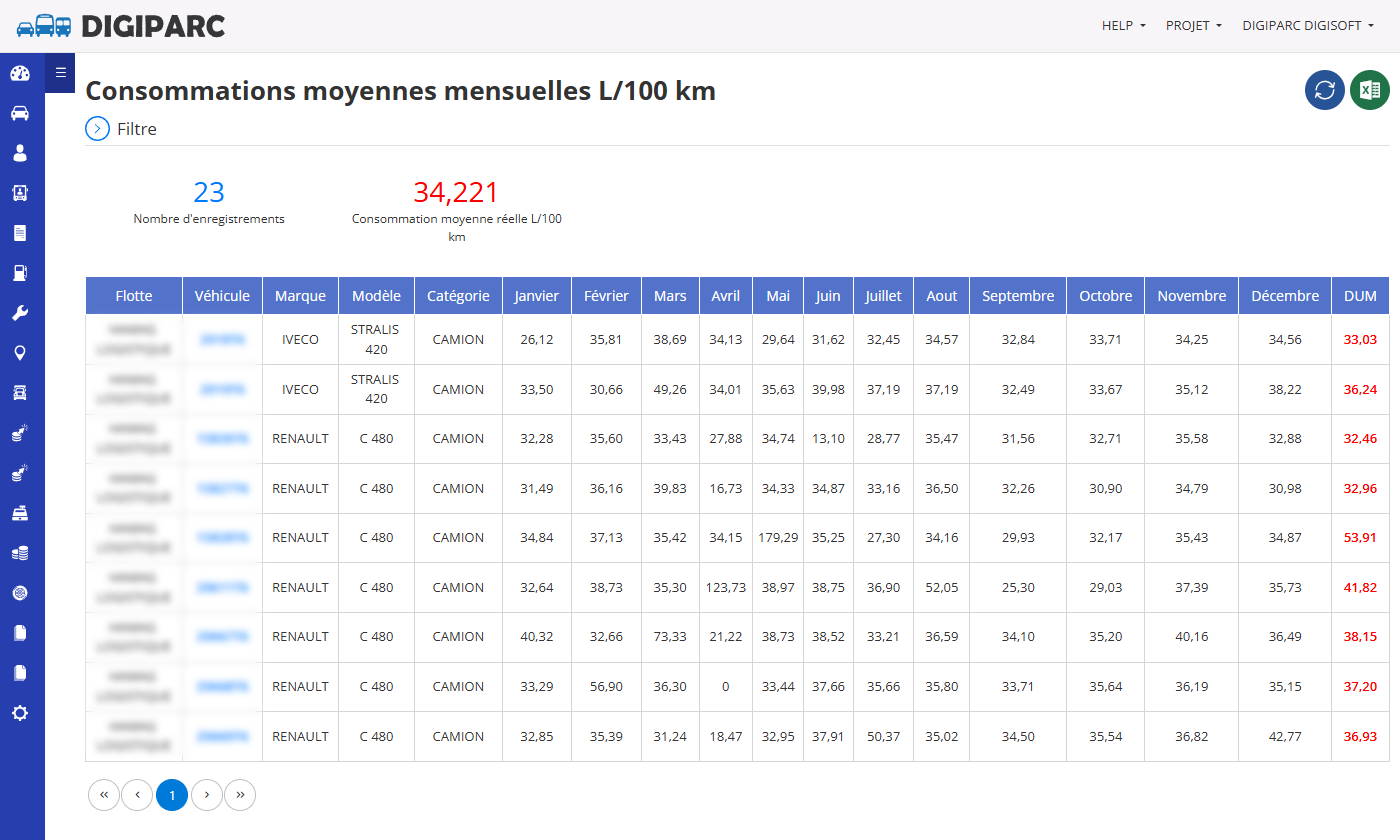
- Flotte: Groupe auquel appartient le véhicule dans la gestion du parc.
- Véhicule: Numéro d’identification ou d’immatriculation du véhicule suivi.
- Marque: Constructeur du véhicule (exemple : Renault, Iveco, Volvo, etc.).
- Modèle: Modèle spécifique du véhicule concerné.
- Catégorie: Type du véhicule (exemple : camion, bus, utilitaire, etc.).
- Janvier - Décembre: Consommation moyenne de carburant (en litres par 100 km) enregistrée pour chaque mois de l’année.
- DUM (Dernière Utilisation Moyenne): Moyenne de consommation la plus récente enregistrée pour le véhicule, permettant d'évaluer sa tendance actuelle.
Valeur ajoutée du rapport
- Suivi de l’efficacité énergétique: Permet de détecter les véhicules qui consomment trop de carburant par rapport à leur usage.
- Optimisation des coûts: Aide à réduire les dépenses liées au carburant en ciblant les véhicules à optimiser ou à entretenir.
- Détection des anomalies: Identifie des comportements inhabituels (surcharge, conduite agressive, problèmes mécaniques).
- Gestion proactive de la maintenance: Un véhicule qui consomme plus que la moyenne peut nécessiter un entretien spécifique (filtre à air, pression des pneus, etc.).
- Analyse des tendances: Permet d’observer l’évolution de la consommation et de prendre des décisions stratégiques pour améliorer la performance globale de la flotte.
Ce rapport est essentiel pour garantir une exploitation efficace des véhicules et maîtriser les dépenses en carburant.