Module · Reporting
Vehicle Parts
Vehicle Parts
Introduction
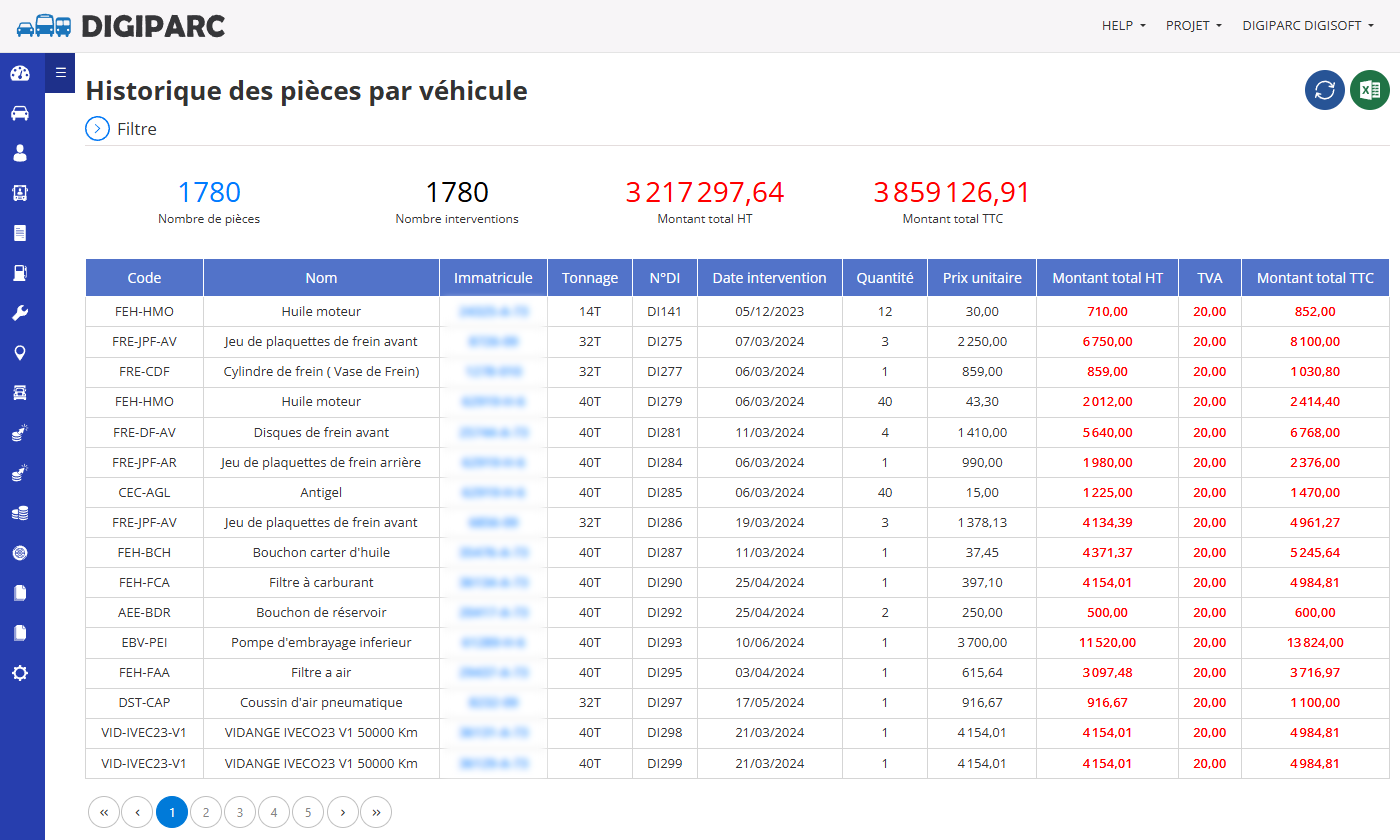
The reportRM007 - Parts history per vehicleallows you to track all the parts used during maintenance interventions on vehicles. It provides complete visibility into parts consumption, cost and frequency of use.
Explanation of table columns
Code
- Uniquely identifies each part used.
- Allows precise tracking of consumed references.
Name
- Refers to the part used (e.g. engine oil, brake pads, air filter).
- Facilitates the interpretation of data for inventory and purchasing management.
registered
- Indicates the registration number of the vehicle concerned.
- Allows you to analyze parts consumption per specific vehicle.
Tonnage
- Specifies the vehicle's load capacity (e.g. 14T, 32T, 40T).
- Useful for identifying parts suitable for different vehicle categories.
DI No.
- Corresponds to the number of the intervention file in which the part was used.
- Allows you to establish a link between interventions and parts consumed.
Intervention date
- Indicates the date the part was used in an intervention.
- Used to track replacement and repair history.
Quantity
- Represents the number of room units used during the intervention.
- Utile pour évaluer la consommation et anticiper les besoins en stock.
Unit price
- Shows the cost of one unit of the part.
- Allows you to calculate the total cost of parts used.
Total amount excluding tax
- Corresponds to the total cost of the parts before the application of VAT.
- Used to analyze spare parts expenses.
VAT
- Indicates the VAT rate applied to the parts used.
- Allows you to calculate the total cost with taxes.
Total amount including tax
- Represents the total cost of parts after applying VAT.
- Allows you to know the exact amount spent for the intervention.
Added value of the report
TEAreport RM007 - Parts history by vehicleoffers several advantages for maintenance management:
- Inventory optimization: Allows you to anticipate needs for spare parts and avoid stock shortages.
- Tracking maintenance costs: Helps analyze parts expenses per vehicle and better manage the budget.
- Intervention planning: Identifies the most frequently replaced parts to improve preventative maintenance.
- Performance Analysis: Highlights vehicles requiring frequent repairs for better fleet management.
Conclusion
TEAreport RM007 - Parts history by vehicleis an essential tool for optimizing spare parts management, tracking maintenance costs and improving vehicle operational efficiency.